How Outsourcing Land Development Design Helps US Civil Engineering Firms Handle Project Backlogs in 2026
Outsourcing land development design means partnering with a specialized external drafting and design team for grading plans, utility layouts, plat drawings, erosion control, and site plans to supplement in-house engineering capacity. For US civil engineering firms facing 2026’s staffing shortage, it directly reduces project backlogs by adding trained CAD and design capacity on demand, without the cost or lead time of hiring full-time staff.
Land development projects involve multiple decisions before detailed design can begin. Engineers must evaluate site conditions, grading, drainage, utilities, roadways, land use, and development constraints.
In 2026, artificial intelligence is increasingly becoming part of the technology stack used to support these decisions.
AI does not replace civil engineers. Instead, it can help engineering teams analyze information faster, identify potential issues earlier, automate repetitive tasks, and improve coordination during site planning.
For civil engineering firms managing increasing workloads, AI-supported workflows can also create opportunities to improve efficiency without compromising engineering review and professional judgment.
Why Civil Engineering Firms Are Facing Backlogs in 2026
The backlog problem isn’t a temporary blip it’s structural, and the numbers back it up. More than half of US engineering firms, 51%, have turned down work because they don’t have enough staff to deliver it, according to the ACEC Research Institute’s Engineering Business Sentiment survey. Roughly a quarter of firms (26%) say they’re declining profitable projects for the same reason not a lack of demand, but a lack of hands to do the work.
Three forces are converging to create this pressure in 2026:
- A structural talent gap. The ACEC Research Institute projects an annual shortfall of roughly 18,000 engineers entering the field relative to those retiring or leaving, while broader industry estimates put the 2026 engineering and construction worker shortfall near 499,000. Graduates simply aren’t replacing outgoing senior staff fast enough.
- Sustained infrastructure demand. ASCE estimates $9.1 trillion in infrastructure investment is needed between 2024 and 2033 to bring US systems to a state of good repair and even with recent federal funding, that leaves a projected $3.7 trillion gap. Demand for land development, site design, and civil drafting work isn’t slowing down.
- A 2026 funding and scheduling squeeze. Key authorizations tied to the 2021 Infrastructure Investment and Jobs Act are set to expire in 2026 the so-called “funding cliff” pushing municipalities and developers to move projects through design and permitting faster, ahead of any funding uncertainty. That compresses timelines right when firms have the least spare capacity to absorb it.
The result: full pipelines, thin teams, and design departments absorbing overflow work that used to go to a fifth or sixth hire a hire that, in most markets, doesn’t exist to be made.
What Outsourcing Land Development Design Actually Involves
Outsourced land development design isn’t a vague “back-office” arrangement it’s targeted technical drafting and design support for the deliverables that pile up first when a firm is short-staffed:
• Grading and drainage plans — site grading, cut/fill balancing, and stormwater management design
• Utility layout drawings — water, sewer, and dry utility routing and coordination
• Site plans and plat drawings — subdivision layouts, lot lines, easements, and plat preparation for municipal review
• Erosion and sediment control plans — SWPPP-supporting drawings for permit compliance
• Construction detail sheets — standard details, cross-sections, and specification support
A capable outsourcing partner works inside the same CAD environment your team already uses (typically Civil 3D), follows your firm’s drafting standards and QA/QC process, and delivers redline-ready or stamp-ready drawings your licensed engineers review and approve the engineering judgment and sign-off stay in-house; the drafting hours get offloaded.
How Outsourcing Directly Solves the Backlog Problem
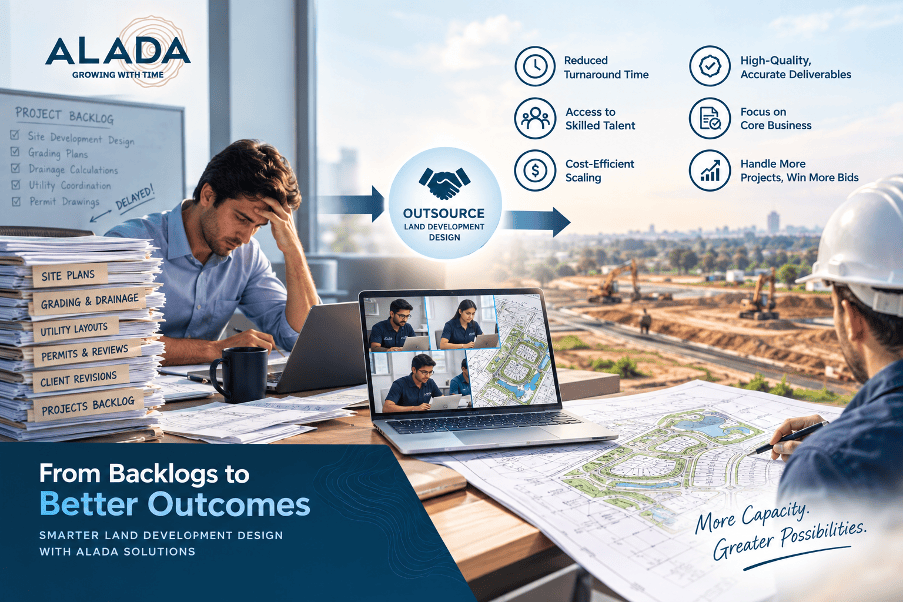
Backlogs form when project volume outpaces available design hours. Outsourcing attacks that math directly it adds hours, not headcount, and it does so on a timeline measured in days, not months.
| Factor | In-House Hiring | Outsourced Design Support |
|---|---|---|
| Time to add capacity | 3–6+ months (recruiting, onboarding) | Days to 1–2 weeks |
| Cost structure | Fixed salary + benefits, year-round | Variable, scoped to active project load |
| Response to demand spikes | Slow — overtime or turned-down work | Fast — scale up or down per project |
| Risk during slow periods | Idle payroll cost | No ongoing overhead |
| Access to specialized CAD skill | Limited to local hiring pool | Broader talent pool, US-standard trained |
| Impact on senior engineer time | Senior staff pulled into drafting | Senior staff stay focused on review, design intent, client work |
The practical effect shows up in three places at once:
• Turnaround speed. Projects sitting in a drafting queue move again because there’s capacity to actually draw them, not just schedule them.
• Cost flexibility. Firms pay for design hours against real project revenue instead of carrying a full-time salary through slow stretches directly addressing the margin pressure of turning down profitable work for lack of staff.
• Senior engineer leverage. With drafting-heavy tasks offloaded, PEs and project managers spend more time on design decisions, client coordination, and permit strategy the work that actually requires their license and experience.
What to Look for in an Outsourced Land Development Design Partner
Not all outsourced drafting support is equal. Before handing off backlog work, firms should evaluate a partner on:
• US code and standards fluency — familiarity with local and state DOT, municipal, and county submittal requirements, not just generic CAD competence
• Software and standards compatibility — works natively in Civil 3D (or your platform) and can match your firm’s layer standards, templates, and title blocks
• Defined turnaround SLAs — clear, committed timelines per drawing type, so backlog relief is predictable, not aspirational
• QA/QC process — a documented review step before drawings come back to your team, reducing rework
• Communication and overlap hours — enough working-hours overlap with your US team for real-time markups and revisions, not 24-hour email round trips
• Data security practices — clear handling of client project files, NDAs, and secure file transfer protocols
Addressing the Common Objections
“Will drawing quality suffer?” A structured partner works from your firm’s standards and templates, with an internal QA/QC pass before delivery your engineers still review and stamp every drawing, so quality control never actually leaves your firm’s hands.
“Is our project data secure?” Reputable outsourced design partners operate under signed NDAs and secure file-transfer protocols, the same baseline any subconsultant relationship requires.
“Won’t communication gaps slow things down?” This is a partner-selection issue, not an inherent outsourcing limitation firms that confirm overlap working hours and a single point of contact upfront avoid the back-and-forth delays that cause the most friction.
Frequently Asked Questions (FAQs)
What is outsourcing land development design?
It’s contracting an external CAD/design team to produce drawings like grading plans, utility layouts, and plats, while your in-house engineers retain full review, revision, and stamping authority over the final deliverables.
How does outsourcing help with civil engineering firm backlogs in 2026?
It adds design and drafting capacity within days instead of the months a new hire takes, letting firms clear queued projects without the fixed cost of expanding headcount during a documented industry-wide staffing shortage.
Is outsourced land development design only for large firms?
No, it’s often most valuable for small-to-mid-size firms (10–150 employees), since it lets them absorb project surges without the overhead of hiring a full-time drafter for work that may not stay steady year-round.
Does outsourcing replace licensed engineers?
No. Outsourced partners handle drafting and design production; licensed engineers at your firm retain all design decisions, review authority, and stamping responsibility.
How quickly can outsourced design capacity be added to a project?
Most outsourced land development design partners can begin work within days to two weeks of scoping a project, compared to the 3-to-6-month timeline typical of hiring and onboarding a new in-house drafter.
What types of drawings can be outsourced first?
Grading and drainage plans, utility layout drawings, plat and subdivision drawings, and erosion control plans are the most commonly outsourced deliverables, since they’re high-volume, standards-driven, and well-suited to remote production.
Getting Ahead of the 2026 Backlog
The staffing shortage behind today’s backlogs isn’t resolving on its own the pipeline of infrastructure and land development work is only growing, and the talent pool filling it isn’t growing at the same rate. Firms that build outsourced design capacity into their workflow now are the ones positioned to keep saying yes to project intake instead of turning away profitable work.
Alada Solutions provides outsourced land development design and CAD drafting support for US civil engineering and land development firms including land survey drafting, stormwater drainage design, and grading and utility plan production built around US code compliance and your firm’s own drafting standards.